
-
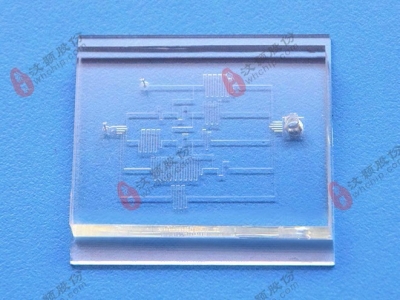
Microfluidic concentration gradient chip -
Microfluidic concentration gradient chip
Material:PMMA/GLASS/PDMS ETC.In microfluidic chip-channel networks, the fluid is mainly laminar, so that when two or more different reagents flow into the same channel, the reagents can maintain their
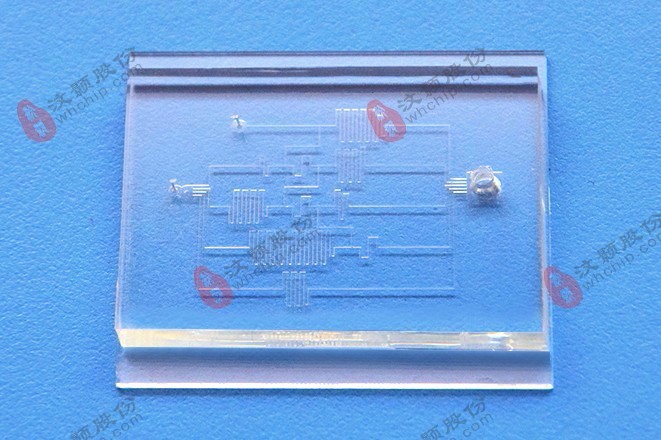
Material:PMMA/GLASS/PDMS ETC.
In microfluidic chip-channel networks, the fluid is mainly laminar, so that when two or more different reagents flow into the same channel, the reagents can maintain their flow patterns unchanged and only occur at the phase-to-phase contact Reaction or molecular diffusion, the concentration gradient formed has high stability and reproducibility, and a series of complex concentration gradients can be obtained by changing the configuration design of the channel network and the initial flow concentration and combination order, utilizing Microfluidic concentration gradient chip can simulate the external environment, the establishment of chemical concentration gradient, at the cell and individual level to study organisms on the external environment changes in response. The technology has been widely used in drug screening, biochemical chemotaxis, toxicity and other research areas.

Drug screening
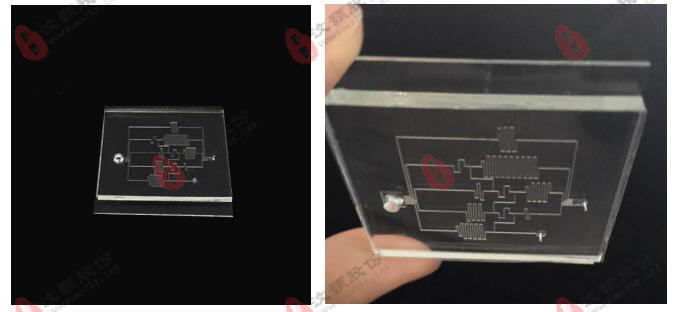
With the development of new drug development technology, the activity test of new drug compounds has gradually changed from early confirmatory experiments to screening experiments, so-called drug screening. With the development of combinatorial chemistry and computational chemistry, people began to have the ability to synthesize and separate many kinds of compounds in a short period of time. Therefore, drug screening has become an important part in the development of new drugs during the development of modern new drugs. Microfluidic concentration gradient chip for drug screening experiments, compared with the traditional porous plate technology, eliminating the need to configure and distribute a variety of drugs in different concentrations of complex operations, greatly simplifying the cell plating, loading, washing, marking and other operations Process, while significantly reducing the consumption of cells and reagents at the same time, high-throughput screening.
Modeled biological chemotaxis
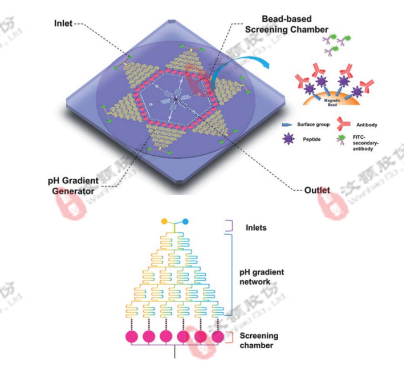
Model organisms react to liquids and air-borne chemicals and experience water-soluble initiators and volatiles in the micromolar range, giving rise to tendency or avoidance behavior. The successful availability of a controlled concentration gradient has become the key to studying the pattern of chemotaxis. Microfluidic concentration gradient chips are able to freely control and create chemical concentration gradients, form concentration gradients with short time, and provide high reproducibility of experimental conditions, thus becoming an advantageous tool for studying the mode of biochemical chemotaxis.
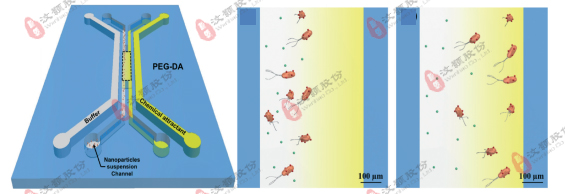
Toxicity evaluation
Microfluidic concentration gradient chips can generate different concentration gradients of chemical factors to act on marine microalgae, zebrafish and other subjects. The biochemical reaction is stimulated by different concentrations of chemical factors in the test subject to be used as a feedback signal for chemical toxicity Comment
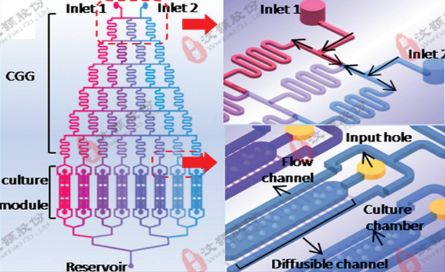
Concentration gradient chip based on the principle of laminar flow diffusion, by changing the channel network configuration and initial solution concentration, can generate linear, exponential and other concentration gradient. The use of concentration gradient chip to simulate the changes in the external environment can be applied to drug screening, chemotaxis and toxicity assessment.
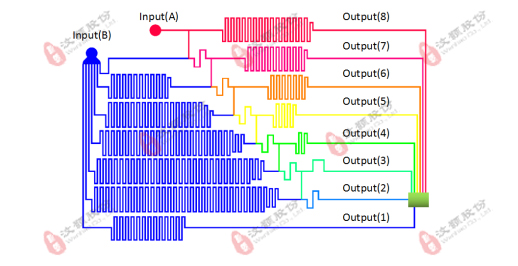
Figure 1. Microfluidic linear eight-gradient chip schematic
Table 1. Linear Eight-Gradient Concentration Gradient Concentration at chip exit
Export | 1 | 2 | 3 | 4 | 5 | 6 | 7 | 8 |
concentration | 0 | (1/7)C | (2/7)C | (3/7)C | (4/7)C | (5/7)C | (6/7)C | C |
Note: C is the sample solution concentration.
Characterize the results
We performed fluorescence characterization using a linear, eight-gradient chip of PMMA. Figure 2 shows a fluorescence image of the FITC aqueous solution and deionized water at 1 μL / min flow rate through the exit of the chip. The fluorescence intensity was analyzed using Image-pro software. As can be seen from the figure, the outlet fluorescent intensity maintains a good linear relationship.
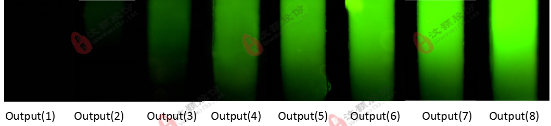

Figure 2. Linear eight-gradient chip fluorescence characterization
Instructions for use
1.Input (A) traffic is equal to Input (B) traffic;
2. The sample solution and the buffer solution is a dilute solution of similar viscosity;
3. Note the first injection of the channel filled with buffer solution to avoid bubbles in the channel;
4. Inlet flow is less than 2μL / min.
Custom chip customers need to provide parameters
Outlet flow
Export concentration
3. Channel cross-section size;
4. Diffusion coefficient between sample solution and buffer solution.
Wen Wei shares to provide based on PMMA, glass, PDMS and other materials microfluidic concentration gradient chip design, processing, production and other related services and technical output and training.